研究發現,全世界熱帶森林從大氣中吸收二氧化碳的能力正在衰退,而位於高緯度寒冷地區的北方森林,吸收二氧化碳的速度正在增加。
這項新研究結合遙測資料和數學模型,詳細揭露1992年至2015年地球上所有生物區系的碳損失和碳吸收。研究顯示,世界上最重要的兩個陸地儲碳生態系統——熱帶雨林和北寒林,正在發生變化。
位於高緯度寒冷地區的北方森林,吸收二氧化碳的速度正在增加。照片來源:IBM(CC BY-NC-ND 2.0)
作者表示,研究探討的這段期間,熱帶森林碳損失的主要驅動力是森林砍伐。受影響特別嚴重的地區包括、印尼和東南亞。
另一位科學家表示,目前還不清楚是什麼因素使北寒林的碳增加。一個可能性是二氧化碳施肥效應,也就是大氣中二氧化碳含量增加促進植物生長。
整體而言,研究結果顯示熱帶森林吸收二氧化碳的能力衰退,相當令人擔憂。人類活動產生的溫室氣體排放約有30%被土地吸收,使其成為重要的「」。當樹木和其他類型的植群進行光合作用時,土地從大氣中吸收二氧化碳。植物利用二氧化碳長出枝條、根和葉。也就是說,只要植物還活著,就是長期的碳匯。
熱帶森林、北寒林合計佔土地儲碳的53% 其中北寒林的貢獻逐漸增加
這項新的發表在《自然生態與演化(Nature Ecology and Evolution)》期刊上,使用多種技術來繪製1992年至2015年全球所有生物區系的碳損失和碳吸收狀況,包括旱地、稀疏植生地、苔原(一種北極環境),以及溫帶林、北寒林和熱帶森林。
(溫帶森林所在地氣候溫和,四季分明,而北寒林則位於較冷的高緯度地區,特徵是常綠的松樹、雲杉和落葉松。)
下圖顯示了研究中所含的各種生物區系分布。溫帶、寒帶和熱帶生態系統進一步細分為「低矮植生地」或「森林」。「低矮植生地」表示未被原始森林覆蓋,地景以草、農田、灌木或莽原為主的區域。
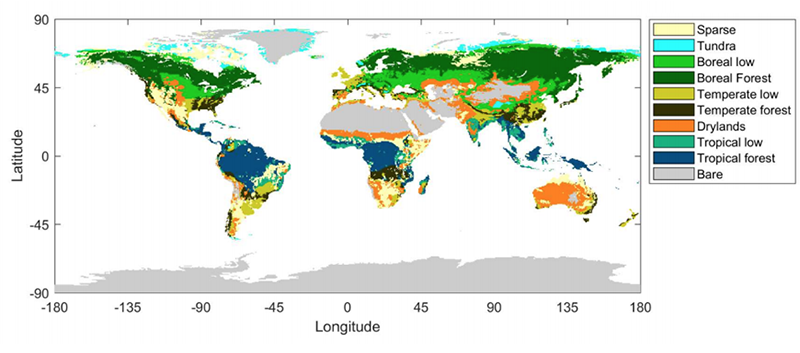 1992-2015年世界陸地生物群系分布,包括稀疏植生地(黃色)、苔原(藍色)、北寒低矮植生地(淺綠色)、北寒林(深綠色)、溫帶低矮植生地(橄欖)、溫帶森林(黑色)、旱地 (橙色)、熱帶低矮植生地(綠松石)、熱帶森林(深藍色)和裸露地(灰色)。 資料來源:Tagesson et al. (2020)
 作者結合數學模型和遙測資料分析每個地區的碳儲量。這些資料來自微波偵測「地表生物量」變化的衛星。地表生物量是覆蓋陸地表面的所有活植物的生物量,包含樹枝、樹葉、樹幹和落葉。
呼應過去研究,該研究發現熱帶森林和北寒林是最重要的儲碳生物群落。研究期間範圍內,這兩個生物群系合計佔土地儲碳的一半以上(53%)。
然而,來自瑞典隆德大學的主要作者托本.塔格森(Torben Tagesson)博士說,這兩個地區的碳儲存能力有所差異。「研究結果讓我們掌握二氧化碳吸收量在世界各地的分布情況,並顯示熱帶森林的貢獻正在大大減少。同時北寒林的貢獻正在增加。」
整體而言,土地碳匯在研究期間內有所增加,主要是因為北寒林吸收了更多的二氧化碳。研究發現,從1992年至2015年,陸地儲碳增加了10億噸。
下圖更深入地說明了這種差異。它顯示1992年至2015年期間,北寒林(黑線)和熱帶森林(紅線)對陸地碳匯的貢獻。上色區域表示誤差範圍。作者說,熱帶森林的不確定性較大,因為它們對影響碳損失和獲取的因素更加敏感。
 1992-2015年,北寒林(黑色)和熱帶森林(紅色)對陸域碳匯的貢獻。上色區域顯示不確定性範圍。資料來源:Tagesson et al. (2020)
 該圖顯示,熱帶森林很可能從陸地碳匯的最大貢獻者變為第二大,輸給了北寒林。塔格森說,下降的主要原因是熱帶地區的森林砍伐。「人為土地利用和土地覆蓋變化對熱帶森林的儲碳能力有很大的影響。」
推測施肥作用增加北寒林吸碳 研究:最快2030年就會失效
值得一提的是,該研究僅探討到2015年,但此後,世界各地熱帶森林砍伐都在加速。去年年底,巴西亞馬遜地區的森林砍伐達到十年來新高,而中非和西非的森林砍伐也達到高點。
另一份發表在《自然永續性(Nature Sustainability)》期刊的發現,從2008年到2014年,巴西亞馬遜流域的次生林損失增加了一倍以上,導致釋放出26億噸碳(「次生林」是指近期重新生長而成的森林)。
研究發現,熱帶地區的碳損失還受到乾旱等氣象因素的影響。會導致樹木死亡並加劇野火的危險。
巴西亞馬遜流域的次生林損失增加了一倍以上,導致釋放出26億噸碳。照片來源:CIAT/NeilPalmer(CC BY-SA 2.0)
塔格森說,北寒林吸收二氧化碳速度變快的原因難以理解。研究者發現,在研究期間內,土地利用變遷和氣象因素在北寒林碳儲量的增加上僅扮演次要角色。但是,他認為二氧化碳施肥效應可能發揮了作用。植物在光合作用中使用二氧化碳,因此,隨著人類釋放出更多的二氧化碳,植物似乎生長得更快,並且儲存更多的碳。
就算在研究期間,二氧化碳施肥作用增強了北方森林吸收二氧化碳的能力,但這種作用可能會減緩甚至逆轉。未參與研究的慕尼黑科技大學地表相互作用學者安賈.拉米格(Anja Rammig)教授說:
「問題在於:這些碳能在森林中保留多久?可能很快就會流失,因為樹木長得越快,就會死得越早。如果樹木提早死亡,可能10或20年後換看到一個完全逆轉的局面。」她評論,這項新研究相當紮實地描繪出陸域碳匯變化的全貌。「因為作者研究的是地表生物量,而不僅僅是林業研究中經常使用的『綠化』效果。」
「綠化」是從上而下測量土地隨著時間的推移而變綠的程度,通常來自高解析度衛星影像。另一方面,地表生物量是覆蓋陸地表面所有活植物的質量。這考慮了所有生物量,而非上到下的估計,因此是測量森林碳匯更完整的方法。
未參與研究的波士頓大學氣候森林動態學者藍格.米尼(Ranga Myneni)教授表示:「這項研究的價值在於釐清主要生物區系對陸地碳匯的貢獻,以及這些貢獻隨時間的變化。」
Tropical forests losing ability to absorb CO2, study says by DAISY DUNNEThe world's tropical forests are losing their ability to remove CO2 from the atmosphere, while boreal forests are absorbing emissions at an increasingly fast rate, a study finds.
The new analysis uses a combination of remote-sensing data and modelling to create a detailed picture of carbon loss and gain across all of Earth's biomes from 1992 to 2015.
It shows a diverging picture in the world's two most important ecosystems for storing carbon on land: tropical rainforests and "boreal" forests, which are found in the cold climate of the high latitudes.
The chief driver of carbon loss in tropical forests over the study period was deforestation. Particularly affected areas are likely to include the Amazon, Indonesia and southeastern Asia, the lead author tells Carbon Brief.
It is not fully clear what is driving carbon gains in boreal forests, another scientist tells Carbon Brief. However, one likely driver is the "CO2 fertilisation effect" – a term describing how increasing CO2 levels in the atmosphere can boost plant growth.
Overall, the findings paint a comprehensive picture of a "worrying" shift in the ability of tropical forests to absorb CO2 emissions, she adds.
Around 30% of the greenhouse gas emissions from human activity are absorbed by the land – making it an important "carbon sink".
The land takes in CO2 from the atmosphere when trees and other types of vegetation carry out photosynthesis, the process where plants use CO2 to build new materials, such as shoots, roots and leaves. This means that, as long as plants are alive, they can act as long-term "sinks" of CO2.
The new study, published in Nature Ecology and Evolution, uses a host of techniques to create a detailed picture of carbon loss and gain from 1992 to 2015 across all of the world's biomes, which include drylands, sparse land, tundra (an Arctic environment) and temperate, boreal and tropical regions.
("Temperate" forests are found in moderate climates and are known for experiencing four seasons, while boreal forests are found in cooler high-latitude regions and are characterised by evergreen pines, spruces and larches.)
The map below shows the distribution of the various biomes included in the study. Temperate, boreal and tropical ecosystems are further broken down into "low" or "forest". "Low" is used to indicate regions that are not covered by primary forest, but instead made up of grass, croplands, shrubland or savannah.
The distribution of the world's terrestrial biomes from 1992-2015, including sparse (yellow), tundra (blue), boreal low (light green), boreal forest (dark green), temperate low (olive), temperate forest (black), drylands (orange), tropical low (turquoise), tropical forest (dark blue) and bare (grey). Source: Supplementary information, Tagesson et al. (2020)
To analyse carbon storage in each region, the authors use a combination of modelling and remote-sensing data. This data comes from satellites that use microwaves to detect changes in "above-ground biomass" – a measure of all the living plant matter that covers the land's surface, including branches, leaves, trunks and fallen foliage.
In line with previous research, the study finds that tropical and boreal forests are the most important biomes for storing carbon. Together, these two biomes accounted for more than half (53%) the carbon held by land over the study period.
However, these two regions are now showing "divergence" in their ability to store carbon, says Dr Torben Tagesson, study lead author and researcher at Lund University in Sweden. He tells Carbon Brief:
"This study gives us an insight in how this CO2 uptake is distributed across the world – and we show that the contribution of the tropical forests is substantially decreasing. At the same time, the contribution of boreal forests is increasing."
Overall, the land carbon sink increased over the study period – largely as a result of the boreal forests absorbing more CO2, he adds. The study finds that the land sink grew by an additional 1bn tonnes of carbon from 1992-2015.
The chart below gives a more in-depth picture of this divergence. It shows the contribution of boreal (black line) and tropical (red line) forests to the land carbon sink from 1992 to 2015.
The shaded areas show the margins of error. (The uncertainties are larger for tropical forests because they are more sensitive to individual drivers of carbon loss and gain, the authors say.)
The contribution of boreal (black) and tropical (red) forests to the land carbon sink from 1992-2015. The shadow areas show margins of uncertainty. Source: Tagesson et al. (2020)
The chart shows how tropical forests have likely gone from being the largest contributor to the land carbon sink to the second largest behind boreal forests.
The primary reason for this decline is deforestation in tropical regions, says Tagesson:
"We can clearly see that the anthropogenic land use and land cover change have a big impact for the contribution of tropical forests."
It is worth noting that the study only looks at changes up until 2015 – and since then tropical deforestation has accelerated in many parts of the world, he adds.
Late last year deforestation of the Brazillian Amazon reached its highest level in a decade, while central and west Africa also saw a spike in forest loss.
A second study published today in Nature Sustainability finds that loss of "secondary forest" in the Brazillian Amazon more than doubled from 2008 to 2014 – causing the release of 2.6bn tonnes of carbon. ("Secondary forest" refers to forest that was replanted relatively recently.)
Carbon loss in tropical regions was also affected by "meteorological factors" such as droughts – which cause tree deaths and worsen the risk of wildfires, the study finds.
The reason why boreal forests are absorbing CO2 at an increasingly fast rate is more difficult to tease out, says Tagesson. The study finds that both land-use change and meteorological factors played "minor roles" in the observed increase in boreal carbon storage over the study period.
However, it is likely that the "CO2 fertilisation effect" is playing a role, he adds. Plants use CO2 in photosynthesis and, so, as humans emit more of it, it appears that plants are growing faster – and storing more carbon.
Though the CO2 fertilisation effect has boosted the ability of boreal forests to absorb CO2 over the study period, it is possible that this effect may slow down or even reverse, says Prof Anja Rammig, a researcher of land-surface interactions from the Technical University of Munich, who was not involved in the study. She tells Carbon Brief:
"The question is: How long will this carbon stay in forests? It could be that this carbon gets lost earlier because if trees are growing faster, they could die younger. If trees are dying younger, we could expect to see a completely reversed picture in 10 or 20 years."
The new study is "very solid" and creates a "comprehensive picture" of how the land carbon sink is changing, she adds. "A real strength is the authors look at above-ground biomass, rather than just 'greening', which is often used in forestry studies."
"Greening" is a top-down measurement of how much more green the land has become over time. It is often derived from satellites that can create high-resolution images.
On the other hand, above-ground biomass is a measure of all the living plant matter that covers the land's surface. Because it takes into account all biomass, rather than making a top-down estimate, it can be seen as a more complete way of measuring forest carbon, she says.
The high-resolution tools used in the study make it "extremely novel", agrees Prof Ranga Myneni, a researcher of climate-forest dynamics from Boston University, who was not involved in the research. He tells Carbon Brief:
"I think the value of this study is in being able to tease out contributions of different biomes to the land carbon sink and then look at the temporal dynamics of those contributions, principally in the case of tropical and boreal forests."
※ 全文及圖片詳見:()
參考資料
- Tagesson, T., Schurgers, G., Horion, S. et al. Recent divergence in the contributions of tropical and boreal forests to the terrestrial carbon sink.(2020),
- Wang, Y., Ziv, G., Adami, M. et al. Upturn in secondary forest clearing buffers primary forest loss in the Brazilian Amazon. Nat Sustain (2020).
※ 本文與 行政院農業委員會 林務局 合作刊登
作者
如果有一件事是重要的,如果能為孩子實現一個願望,那就是人類與大自然和諧共存。
於特有生物研究保育中心服務,小鳥和棲地是主要的研究對象。是龜毛的讀者,認為龜毛是探索世界的美德。
延伸閱讀本站聲明:網站內容來源環境資訊中心https://e-info.org.tw/,如有侵權,請聯繫我們,我們將及時處理
【其他文章推薦】
※如何讓商品強力曝光呢? 網頁設計公司幫您建置最吸引人的網站,提高曝光率!!
※網頁設計一頭霧水??該從何著手呢? 找到專業技術的網頁設計公司,幫您輕鬆架站!
※想知道最厲害的台北網頁設計公司推薦、台中網頁設計公司推薦專業設計師"嚨底家"!!
Orignal From: 全球熱帶森林儲碳能力恐退居第二 森林砍伐是主因
留言
張貼留言